C++ low-latency patterns benchmarked — HFT, cache-friendly layouts, and the tricks that don't reproduce

C++ Low-Latency Patterns, Benchmarked: 15 Tricks from HFT and CppCon 2025 (and Which Claims Don't Reproduce)

Fifteen C++ performance patterns from three sources — Bilokon & Gunduz’s HFT paper at Imperial, Jonathan Müller’s Cache-Friendly C++ deck at CppCon 2025, and Okade & Baker’s C++ Performance Tips at CppCon 2025 — implemented as single-file nanobench programs, run under Docker on GCC 14 with -O2 -std=c++23, every one of them linked to a working Godbolt session. The surprising half: three of the ’textbook’ speedups do not reproduce on a modern CPU. Cache warming is 7x slower than cold. Bitmask branch reduction is slower than the cascade it replaces. This post is the full runbook, numbers included, with the nuance that explains when each pattern actually earns its keep.
April 23, 2026 · 28 min · Pavel Guzenfeld
C++ tools that enforce low-latency patterns — builtins, compiler flags, clang-tidy checks

C++ Low-Latency, Enforced: __builtin_*, Compiler Flags, and clang-tidy, Benchmarked

Follow-up to the 15-pattern HFT post. The first post asked ‘which patterns work?’ This post answers ‘how do you force your team to keep using them?’ Seven new nanobench programs, each with a working Godbolt link, covering __builtin_popcountll (24x faster than a bit-count loop), __builtin_unreachable in switch defaults (1.55x), __builtin_bswap64 (same speed as the portable idiom — GCC already folds it), [[likely]] and [[unlikely]] (no measurable effect on tight loops — an honest null result), and a flags matrix showing -ffast-math + -march=x86-64-v3 giving 6.9x over -O2. Then a .clang-tidy config that fails CI on every common perf regression, with the performance-for-range-copy warning demonstrated at 41x real runtime cost.

April 23, 2026 · 21 min · Pavel Guzenfeld
FPS optimization pipeline for headless Unity simulation

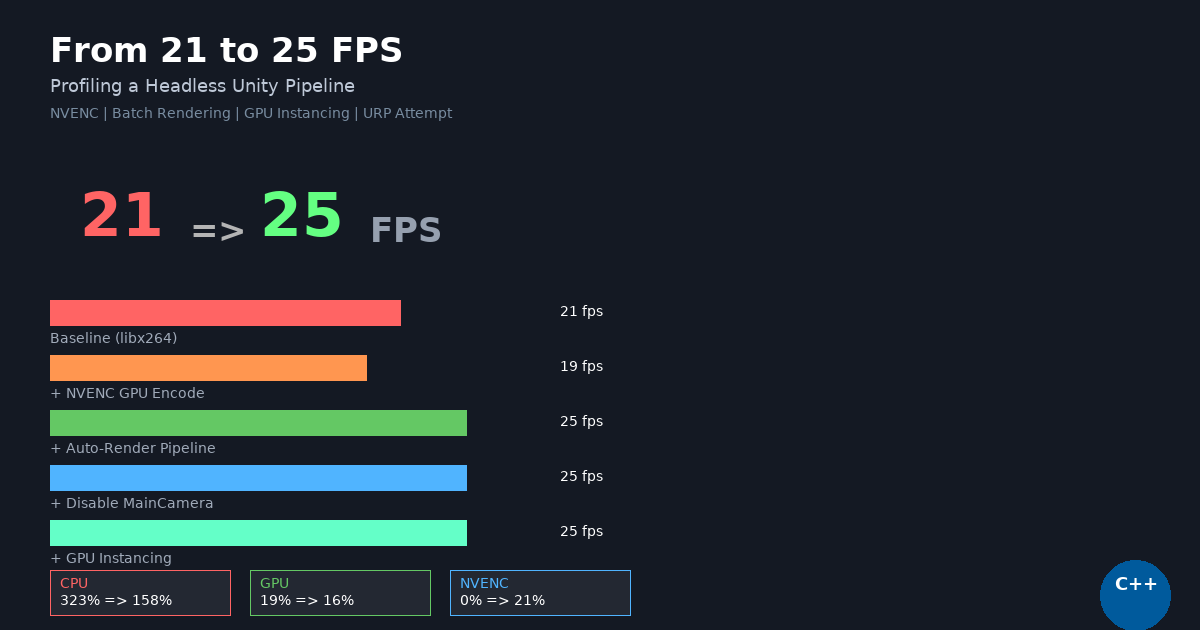
From 21 to 25 FPS: Profiling and Optimizing a Headless Unity Simulation Pipeline

A detailed technical walkthrough of profiling and optimizing a headless Unity simulation from 21 to 25 FPS — covering NVENC GPU encoding, batch camera rendering, GPU instancing, static batching, and the failed URP migration. Every measurement, every dead end, every lesson.

April 4, 2026 · 8 min · Pavel Guzenfeld