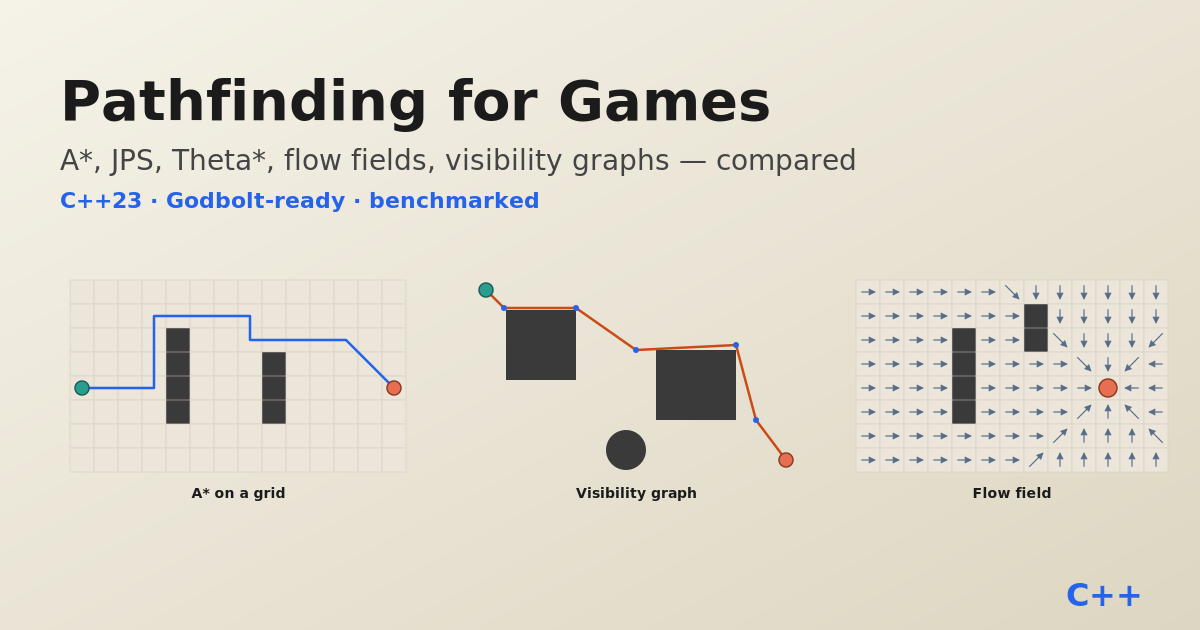
Pathfinding algorithms for games — A*, JPS, Theta*, flow fields, visibility graphs

Game Pathfinding Algorithms, Benchmarked: A*, JPS, Theta*, Flow Fields, Visibility Graphs

Five pathfinders implemented in C++23, each in a single Godbolt-ready file, benchmarked on the same grids. A* is the baseline. JPS expands 22x fewer nodes on open maps yet runs slower than A* in naive form. Theta* produces shorter any-angle paths at 2-8x the cost. Flow fields dominate when many agents share a goal. Visibility graphs — AoE II DE’s approach — need 5 waypoints where A* needs 600. Plus the StarCraft ‘harvesters ignore collisions’ hack and why SC2 switched to navmeshes.
April 18, 2026 · 15 min · Pavel Guzenfeld
O3DE multi-camera rendering performance analysis

Chasing 18 Milliseconds: A Performance Deep Dive into O3DE's Render Readback Pipeline

We spent a full session systematically profiling O3DE’s multi-camera streaming pipeline, testing eight different optimization approaches, and pinpointed the exact bottleneck: 18 ms of fixed overhead in the AttachmentReadback scope system. Here’s what we tried, what we measured, and what it means for the engine.

April 17, 2026 · 7 min · Pavel Guzenfeld
Three live Godot camera streams over RTP/UDP rendered by GStreamer clients

From Unity to Godot: Multi-Camera Streaming at 50 FPS with Async GPU Readback

After O3DE’s 18 ms frame-graph readback made 30 FPS streaming impossible, we tried Godot. It got us there — eventually. This is the full path from 105 FPS on nothing to 50 FPS per camera with three live RTP streams, including every wrong turn and every underdocumented Godot behavior we hit on the way.

April 17, 2026 · 12 min · Pavel Guzenfeld
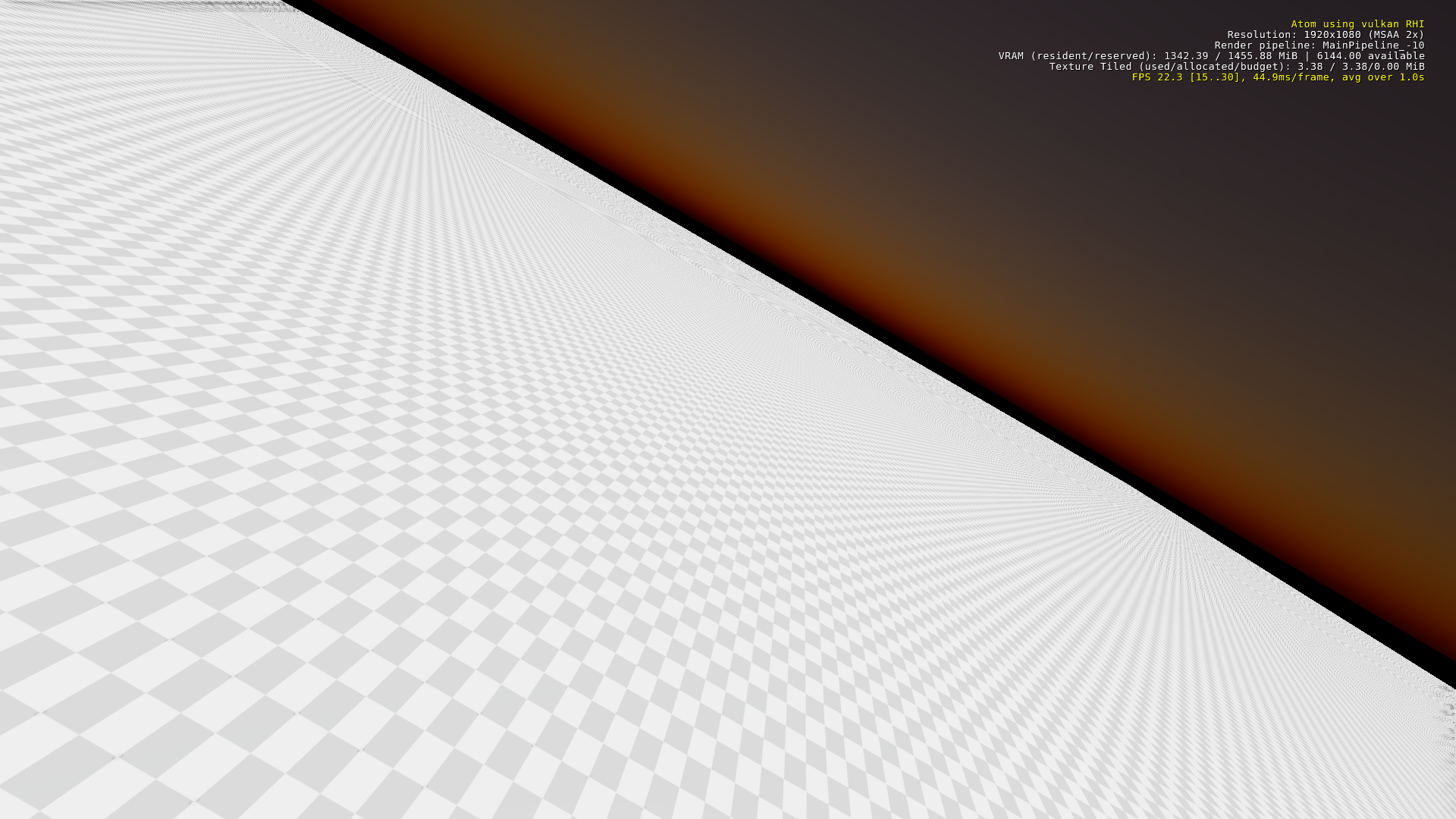
O3DE rendering a ground plane from a camera spawned programmatically inside a headless Docker container

From Unity to O3DE: Multi-Camera Streaming at 1080p in a Headless Docker Container

Exploring whether O3DE can replace Unity as the render engine for a drone simulation that streams multiple 1080p camera feeds via GStreamer. From first scaffold to three live RenderToTexture pipelines in a single session.

April 16, 2026 · 6 min · Pavel Guzenfeld
Six Optiver-Style C++ Problems: Order Books, Dijkstra, DP, and Price Alert Router

Six Optiver-Style C++ Problems: Order Books, Dijkstra, DP, and an AoS→SoA Rewrite

Working through six C++ problems modeled on Optiver’s Senior SWE assessment: supermarket checkout simulation, order book matching, dividend pricing, lattice path DP, Dijkstra with K free edges, and a price-alert router built twice — AoS first, then SoA. Every bug, wrong turn, and data structure tradeoff included.

April 12, 2026 · 18 min · Pavel Guzenfeld
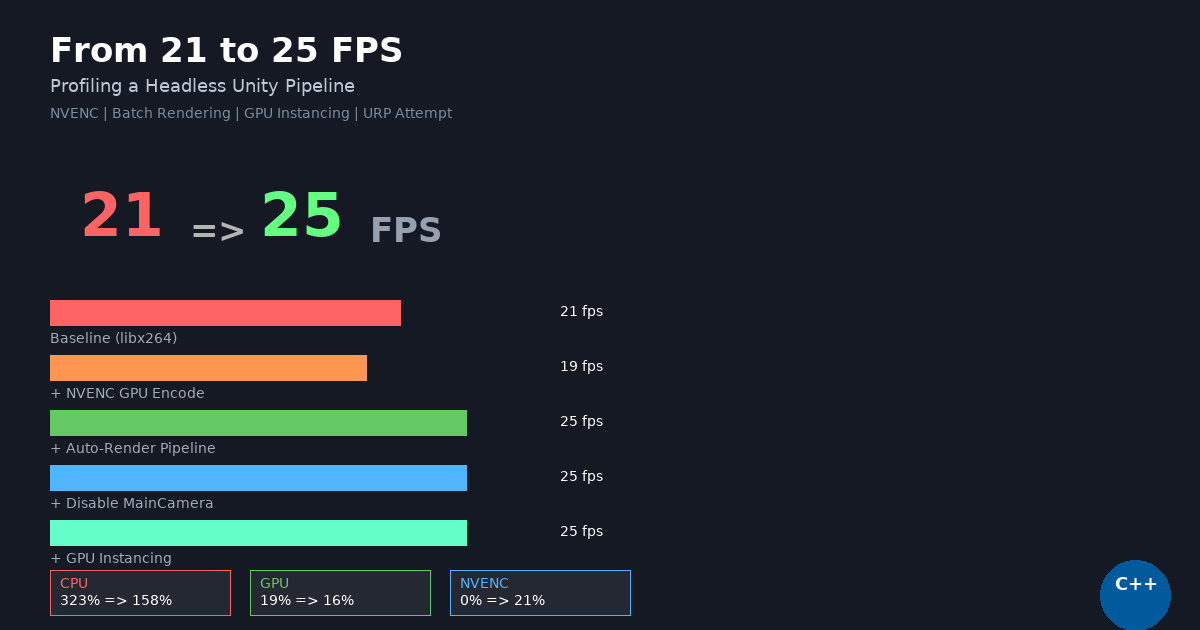
FPS optimization pipeline for headless Unity simulation

From 21 to 25 FPS: Profiling and Optimizing a Headless Unity Simulation Pipeline

A detailed technical walkthrough of profiling and optimizing a headless Unity simulation from 21 to 25 FPS — covering NVENC GPU encoding, batch camera rendering, GPU instancing, static batching, and the failed URP migration. Every measurement, every dead end, every lesson.

April 4, 2026 · 8 min · Pavel Guzenfeld
Fixing O(N²) Entity Addition in ROS 2's CallbackGroup

Fixing O(N²) Entity Addition in ROS 2's CallbackGroup

How a simple erase-remove in every add_timer() call turned entity registration into a quadratic bottleneck — and the 71x speedup from moving cleanup to the right place.

March 23, 2026 · 4 min · Pavel Guzenfeld
Upgrading Householder Right-Side: BLAS-2 to BLAS-3

Upgrading Eigen's Householder Right-Side Application from BLAS-2 to BLAS-3

Eigen’s blocked Householder path only existed for left-side application. I added the right-side equivalent, upgrading M*Q from O(n) rank-1 updates to cache-friendly blocked matrix multiplies.

March 23, 2026 · 4 min · Pavel Guzenfeld
How GCC's fill_n Regressed Eigen's AutoDiffScalar

How GCC's std::fill_n Silently Regressed Eigen's AutoDiffScalar Performance

A performance optimization in Eigen’s fill path assumed all scalar types are equal. GCC’s libstdc++ disagreed — and AutoDiffScalar paid the price.

March 20, 2026 · 4 min · Pavel Guzenfeld