ZII (“Zero Is Initialization”) is a design convention, popularized by Casey Muratori and the Handmade community, where you design every type so that all-bytes-zero is a valid, meaningful default state. RAII is C++’s convention of tying resource lifetime to object lifetime through constructors and destructors. They answer different questions. RAII is about who cleans up and when. ZII is about what a freshly obtained object means before anyone touches it.
RAII in one paragraph
Each object owns its resources. The constructor acquires them and establishes invariants, and the destructor releases them. Lifetimes are granular, one object at a time, and the compiler guarantees cleanup on every exit path, including early returns and exceptions. Ownership is encoded in types (unique_ptr, lock_guard, a File class).
What ZII looks like
struct Track {
    uint32_t id;          // 0 = "no track"
    float    pos[3];      // origin is a fine default
    float    cov[9];      // zero cov is flagged by valid==false anyway
    uint8_t  valid;       // 0 = inactive slot
    uint32_t miss_count;
};

Track tracks[MAX_TRACKS] = {};   // the whole table is ready to use
There is no constructor, no init(), and no “half-constructed” state. memset(&x, 0, sizeof x), = {}, calloc, and fresh OS pages are all correct initialization. The type stays trivially copyable and POD.
ZII usually comes with a few companion ideas:
- Arenas instead of per-object ownership. You allocate many things from one arena and free them all at once (per frame, per request, per level). Lifetime is managed for groups, not individuals, so most objects need no destructor at all.
- Nil/stub objects instead of null. A failed lookup returns a pointer to a shared zeroed object rather than
nullptr. Callers can read from it harmlessly (“empty track, valid=0”) without checking at every step. - Handles/indices instead of owning pointers. Index 0 is reserved as “none.”
The core disagreement
The RAII view says: make invalid states unrepresentable, and let the compiler enforce cleanup per object.
The ZII view says: most objects don’t own anything individually. Per-object acquire/release creates thousands of tiny failure points and scattered allocations. Group lifetimes, make the default state useful, and the problem largely disappears.
| RAII | ZII | |
|---|---|---|
| Default state | Whatever the constructor establishes | All zeros, by design |
| Lifetime granularity | Per object | Per group (arena, frame, pool) |
| Cleanup | Destructor, automatic | Bulk reset, or nothing |
| Failure handling | Throw or error at acquisition | Return zeroed/nil object, keep going |
| Invariants | Enforced by constructor | By convention, since zero must mean something sane |
| Bulk ops | Must run ctors/dtors | memset/memcpy are valid |
Where ZII falls short
- Zero isn’t always meaningful. An ID of 0, a divisor, a quaternion (zero isn’t the identity rotation), or a covariance matrix (zero means “infinitely certain,” which is dangerous in a filter) all need care. You end up adding
validflags or storing values offset from zero. - Silent failures. Nil objects mean a bug can read plausible-looking zeros instead of crashing. That keeps the program running in production but makes it harder to debug.
- Non-memory resources still need real release. File descriptors, sockets, mutexes, CUDA streams, and DeepStream/GStreamer elements have to be closed explicitly. Arenas don’t help with those.
- Weaker type guarantees. Nothing stops someone from reading a field that should have been set.
They combine well
In practice the strongest C++ designs often use both: RAII at the boundary, ZII inside. The arena itself, the GPU context, and the file handle are RAII objects. The data structures allocated inside the arena are zero-initializable PODs with no destructors.
+--------------------------------------------------------------+
| RAII boundary: constructors acquire, destructors release     |
|                                                              |
|   GpuContext   Pipeline   File / Socket   Arena (owns block) |
|                                             |                |
|  +------------------------------------------v-------------+  |
|  | ZII inside: zeroed PODs, no destructors                |  |
|  |                                                        |  |
|  |   Track tracks[MAX_TRACKS] = {};   persistent arena    |  |
|  |   detections, gating, temps        scratch arena,      |  |
|  |                                    reset every frame   |  |
|  +--------------------------------------------------------+  |
+--------------------------------------------------------------+
This mix fits a hard-real-time loop like a 50 Hz tracker especially well. You can use a per-cycle scratch arena that resets every 20 ms, keep fixed-size zero-initialized state tables, and do no heap allocation on the hot path. The setup and teardown of Jetson/DeepStream resources stay RAII, while the per-frame track and measurement data are pure ZII.
What an arena is
An arena (also called a region, bump allocator, or linear allocator) is a large block of memory you allocate once, then hand out pieces of by just moving a pointer forward. You never free individual objects. You free everything at once, by resetting the pointer back to the start.
The whole idea in ~20 lines
struct Arena {
    uint8_t* base;
    size_t   capacity;
    size_t   used;
};

void* arena_push(Arena* a, size_t size, size_t align = alignof(std::max_align_t)) {
    size_t start = (a->used + (align - 1)) & ~(align - 1);   // round up to alignment
    if (start + size > a->capacity) return nullptr;           // or assert / fallback
    a->used = start + size;
    return a->base + start;
}

void arena_reset(Arena* a) { a->used = 0; }   // "free" everything, O(1)

template <typename T>
T* push_zeroed(Arena* a, size_t count = 1) {
    void* p = arena_push(a, sizeof(T) * count, alignof(T));
    if (p) std::memset(p, 0, sizeof(T) * count);              // ZII: zero is valid
    return static_cast<T*>(p);
}
That’s the entire allocator. Allocation is a few instructions: align, add, and compare. Freeing is one store.
base                                    used                    capacity
 |                                        |                          |
 v                                        v                          v
 +--------+--+-----------+--------+-------+--------------------------+
 | Track  |pd| Detection | float[]| ...   |        free space        |
 +--------+--+-----------+--------+-------+--------------------------+
            ^
            alignment padding

 arena_push(size):  start = align_up(used); used = start + size
 arena_reset():     used = 0     (every allocation is "freed" at once)
Why it works
Most allocations in a program aren’t independent. They share a lifetime with a whole group of other allocations: everything for this frame, this request, this parse, or this level. A general-purpose malloc/new pays to track each object individually (headers, free lists, fragmentation handling, thread locking) and then makes you release each one. An arena accepts that the group lives and dies together, so it tracks nothing per object.
What you get
- Speed. Allocation is a pointer bump, and reset is O(1) regardless of how many objects you made.
- Determinism. There are no syscalls, locks, or free-list walks on the hot path, so timing is predictable, which matters a lot under a hard deadline.
- No leaks or double-frees within the group. There’s nothing to forget to free.
- Locality. Objects allocated together sit next to each other in memory, which is cache-friendly.
- Simpler code. Functions can allocate freely without ownership plumbing, because the caller decides the lifetime by choosing which arena to pass in.
The common lifetime patterns
Scratch / per-frame arena. You reset it at the end of every cycle. In a 50 Hz loop, all per-frame temporaries (detections, gating candidates, association matrices, intermediate buffers) come from it, and arena_reset runs once at the end of the 20 ms tick. The steady state is zero heap traffic.
 tick n                      tick n+1                    tick n+2
 |<------- 20 ms ------->|   |<------- 20 ms ------->|   |
 push push push ... reset    push push push ... reset    push ...
 scratch.used: 0 -> peak -> 0   0 -> peak -> 0             0 -> ...
Persistent arena. This one holds things that live for the whole run, such as configuration, lookup tables, and the track table. You allocate them at startup and never reset it.
Temporary scope within an arena. You save used, do some work, then restore it. This acts as a stack-like nested lifetime:
size_t mark = scratch.used;
auto* tmp = push_zeroed<float>(&scratch, n * n);
// ... use tmp ...
scratch.used = mark;   // pop just this chunk
Limitations
- No individual free. If objects have truly independent, unpredictable lifetimes, an arena is the wrong tool. Use a pool (fixed-size slots with a free list) or the general heap.
- Capacity must be planned. You either size for the worst case or support chaining new blocks when one fills. In real-time code, the usual choice is a fixed worst-case size plus an assert or high-water-mark logging, so you learn about overflow during testing instead of in production.
- Destructors don’t run. Anything placed in an arena should be trivially destructible (which is why it pairs with ZII and POD types). An object that owns a file, a mutex, or a
std::vectorwith its own heap buffer will leak that resource on reset. - Dangling pointers after reset. A pointer into last frame’s scratch arena is invalid after the reset, and nothing will warn you. A common debug aid is filling the arena with a poison pattern like
0xCDon reset, so stale reads show up immediately.
Relation to standard C++
C++17 has this built in as std::pmr::monotonic_buffer_resource. You can back it with a fixed buffer and use std::pmr::vector and similar containers on top, which gives you arena allocation while keeping standard containers. Calling release() frees everything at once. It’s heavier than a hand-rolled bump allocator, since every allocation goes through the virtual memory_resource::allocate interface, but it’s a reasonable middle ground when you want STL containers without per-element heap allocation in the loop. How much heavier is measured below.
Benchmark: one frame of 1000 allocations
The workload is one frame of a scratch arena. Allocate 1000 32-byte Detection structs, write two fields into each, then free all of them. The heap variants keep the pointers and free them at the end of the frame, so they do the same group-lifetime work the arena does.
new / delete:new Detection{}per object, thendeleteeach.malloc / freeandcalloc / free: the same with the C allocator.arena_push / arena_reset: the arena above, no zeroing.push_zeroed / arena_reset: the arena with ZII zeroing.pmr::monotonic_buffer_resource / release: the standard resource over a fixed 64 KiB buffer, withnull_memory_resource()upstream. Ifrelease()ever failed to reuse the buffer, the next frame would throw instead of quietly measuring the heap. The resource pointer comes fromget_default_resource(), so the loop only has amemory_resource*, the same as apmrcontainer.
GCC 14.4, -O2 -std=c++23, an i7-12700H pinned to one core, nanobench. Median of three runs:
| variant | ns/frame | ns per allocation | vs malloc |
|---|---|---|---|
new / delete | 9,774 | 9.8 | 0.78x |
malloc / free | 7,650 | 7.7 | 1.0x |
calloc / free | 9,187 | 9.2 | 0.83x |
arena_push / arena_reset | 797 | 0.8 | 9.6x |
push_zeroed / arena_reset | 928 | 0.9 | 8.2x |
pmr::monotonic_buffer_resource / release | 2,003 | 2.0 | 3.8x |
The arena is about 10x faster than malloc and free. Zeroing every object costs about 0.13 ns per allocation on top of the bump, so ZII is close to free here. calloc costs about 1.5 ns more than malloc per object for the same zeroing.
monotonic_buffer_resource takes 2.5x the time of the hand-rolled arena. That’s more than “slightly heavier”, but it is still almost 4x faster than the heap. In the disassembly GCC doesn’t actually make an indirect call. It devirtualizes speculatively: each allocation loads the vtable slot, compares it with monotonic_buffer_resource::do_allocate, and on a match runs an inlined copy built on std::align. I didn’t break down where the rest of the 1.2 ns goes.
This is the best case for malloc: one thread, one size class, and freed blocks go straight back into glibc’s per-thread cache. I didn’t measure mixed sizes, several threads or a fragmented heap. None of them help malloc, and the arena numbers don’t depend on any of them.
The same program on Compiler Explorer:
Godbolt runs on shared machines, so its numbers are slower and noisier than the table. On one run there, the arena was about 4x faster than malloc and pmr about 2.5x. The ordering is the same.
Why new is slower than malloc
new / delete came out about 2 ns per object slower than malloc / free. My first guess was the zeroing from new Detection{}. It isn’t. Same frame, split up, median of three runs:
| variant | x86 ns/frame | Cortex-A78AE ns/frame |
|---|---|---|
malloc / free | 7,792 | 34,318 |
raw ::operator new / ::operator delete | 9,529 | 37,416 |
new Detection / delete | 9,564 | 37,487 |
new Detection{} / delete | 9,653 | 38,027 |
calloc / free | 8,736 | 37,475 |
Raw ::operator new, which zeroes nothing, already has the whole gap. Zeroing adds about 0.1 ns per object on x86. The rest is the wrapper. This is libstdc++ 14 on x86-64:
operator new(size_t)              _Znwm
    test %rdi,%rdi; cmovne        new(0) must return a unique pointer, so 0 becomes 1
    call malloc@plt
    test %rax,%rax; je ...        on null: get_new_handler(), call it, retry or throw
    ret

operator delete(void*, size_t)    _ZdlPvm
    jmp operator delete(void*)@plt
operator delete(void*)            _ZdlPv
    jmp free@plt
The allocator underneath is the same glibc malloc. new adds a call, a trip through the PLT, a size check and a null check on the way in. Sized delete adds two PLT jumps on the way out. That comes to about 1.7 ns per object on x86, 22% of malloc / free, and about 3.1 ns on the Orin, 9%.
The wrapper is there because the standard asks operator new for things malloc doesn’t promise. Each extra instruction pays for one:
- Size 0 becomes 1.
newof zero bytes must return a unique non-null pointer.malloc(0)may return null. - The null check and the handler loop. On failure
newmust call the installed new-handler, which may free memory, and retry. With no handler it throwsstd::bad_alloc.mallocjust returns null. - The call into
libstdc++.so. The globaloperator newandoperator deleteare replaceable. Any program can define its own and it has to win at link time, so the compiler can’t fold the call intomalloc. - Sized
deleteforwarding. Since C++14,deletepasses the object size so an allocator can skip looking it up. glibc’sfreedoesn’t take it, so libstdc++ drops the size and forwards: two jumps for nothing on this stack. jemalloc, tcmalloc and mimalloc do use it.
The trade-off: you get an exception instead of a null you might forget to check, an out-of-memory policy hook, and a global allocator you can swap without touching call sites. You pay a couple of nanoseconds per pair, and that only matters on a path that allocates thousands of tiny objects per frame. That is the path where an arena removes both malloc and the wrapper. If you need the wrapper itself cheaper, you can define operator new and operator delete in your own binary, link with -static-libstdc++, or use an allocator that takes the size from sized delete. I didn’t measure any of these. I didn’t disassemble the aarch64 libstdc++.
Struct of arrays instead of array of structs
One allocation per object is the worst case for the heap. If the frame keeps its detections as a struct of arrays, one column per field, it needs 8 allocations instead of 1000:
struct Detections {
    float*    box_x0;
    float*    box_y0;
    float*    box_x1;
    float*    box_y1;
    float*    score;
    uint32_t* class_id;
    uint32_t* track_id;
    uint32_t* flags;
};
AoS: 1000 allocations, each 32 bytes
 [box box box box score cls trk flg] [box box box box score cls trk flg] ...

SoA: 8 allocations, each 4000 bytes
 box_x0:   [x0 x0 x0 x0 x0 x0 ... 1000]
 box_y0:   [y0 y0 y0 y0 y0 y0 ... 1000]
 ...
 score:    [s  s  s  s  s  s  ... 1000]   <- the loop touches only these two
 class_id: [c  c  c  c  c  c  ... 1000]
Each variant allocates the 8 columns of 1000 elements, writes score and class_id, then frees them. Same machine, median of three runs:
| layout and allocator | allocations per frame | ns/frame |
|---|---|---|
AoS, malloc per object | 1000 | 7,787 |
AoS, one malloc per frame | 1 | 344 |
SoA, malloc per column | 8 | 621 |
SoA, arena_push per column | 8 | 443 |
SoA, push_zeroed per column | 8 | 613 |
| SoA, pmr per column | 8 | 462 |
Cutting the number of allocations matters more than the allocator. With 8 calls, malloc and free add about 180 ns per frame over the arena, and the arena’s lead drops from about 10x to about 1.4x. Each call does cost more: a 4000-byte malloc/free pair comes to about 22 ns, against about 8 ns at 32 bytes. I didn’t find out why. Raising glibc.malloc.tcache_max to 4096 changed nothing.
Zeroing costs more here: push_zeroed clears all 32 KB of columns, about 170 ns, even though the loop writes only two of them. With SoA you can zero only the columns whose zero means something.
One caveat about the fill loop. It is [[gnu::noinline]] in this benchmark so every variant runs the same code. When I let it inline, GCC vectorized the copy in the malloc variant and not the copies in the arena and pmr variants (-fopt-info-vec-all says so). SoA with malloc then came out at about 300 ns, ahead of the arena. I didn’t find the reason, and __restrict locals and a 32-bit loop counter didn’t change it. SoA is supposed to pay off through vectorization, so check the vectorizer report instead of assuming you got it.
On ARM
I ran the same two programs on a Jetson Orin (Cortex-A78AE, aarch64). The compiler and C library are the same gcc:14 image as the x86 run, so GCC 14.4, glibc 2.41, -O2 -std=c++23, pinned to one core. The core ran at its steady 1.5 GHz after a 60-second warmup. Median of three runs:
| variant | ns/frame | vs malloc |
|---|---|---|
new / delete | 37,730 | 0.90x |
malloc / free | 33,841 | 1.0x |
calloc / free | 36,875 | 0.92x |
arena_push / arena_reset | 4,846 | 7.0x |
push_zeroed / arena_reset | 6,377 to 7,600 | 4.5x to 5.3x |
pmr::monotonic_buffer_resource / release | 6,577 | 5.1x |
| struct of arrays | ns/frame |
|---|---|
AoS, one malloc per frame | 1,744 |
SoA, malloc per column | 2,060 |
SoA, arena_push per column | 1,349 |
SoA, push_zeroed per column | 1,757 |
| SoA, pmr per column | 1,382 |
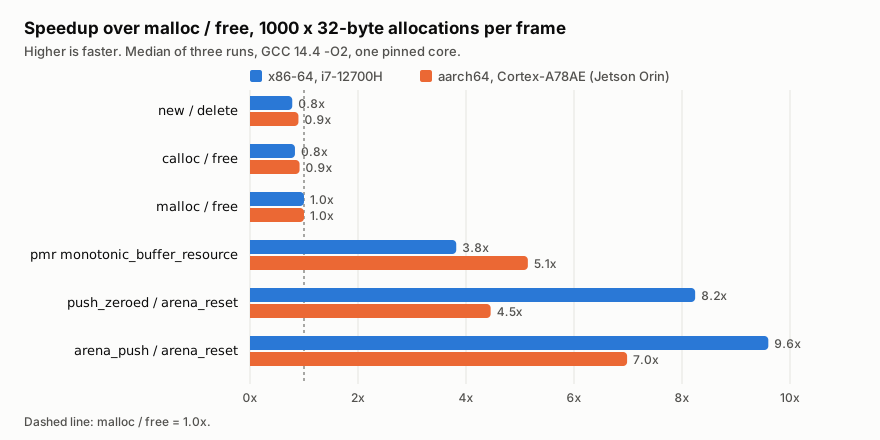
The ordering holds. The arena is 7x faster than malloc here instead of about 10x, and pmr is much closer to the hand-rolled arena: 1.36x slower, against 2.5x on x86.
Zeroing is the odd one out. On x86 it cost 0.13 ns per object. On the Orin it costs 1.5 to 2.7 ns, and push_zeroed jumps between two values from run to run (6,377 and about 7,600). GCC inlines the zeroing as two stp xzr, xzr stores per object, with no memset call, so it isn’t the call. I didn’t find the cause.
On the Jetson GPU
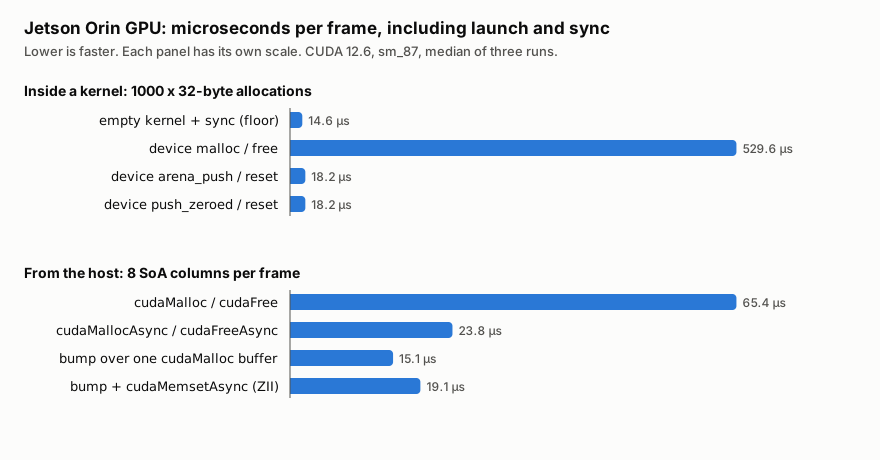
On the GPU there are two places to allocate. A kernel can call device-side malloc per thread, and the host can cudaMalloc buffers every frame. I measured both with CUDA 12.6, -O2 -arch=sm_87, built natively on the Orin. The host thread was pinned to one core, and the GPU stayed at 1.173 GHz under the default governor. Every frame ends with cudaStreamSynchronize, so the numbers are what a frame loop waits for. Median of three runs, all within 0.5%.
Inside a kernel, 1000 threads each allocate one 32-byte Detection, write two fields, and then everything is freed. The arena is a DeviceArena in device memory, and arena_push is a single atomicAdd on its used offset. A one-thread kernel resets it.
| variant | µs/frame |
|---|---|
| empty kernel + sync (floor) | 14.6 |
device malloc / free | 529.6 |
device arena_push / reset | 18.2 |
device push_zeroed / reset | 18.2 |
Device malloc costs about half a millisecond for 1000 allocations, 29x the arena. The arena row is two launches and sits about 3.6 µs above the one-launch floor. At a 20 ms frame budget, device malloc alone eats 2.6% of the frame before any real work. Zeroing 32 bytes per thread doesn’t show up at all.
From the host, each frame allocates the 8 SoA columns of 1000 elements, runs one kernel that fills two of them, and frees them. The arena variants carve the columns out of one cudaMalloc buffer made at startup.
| variant | µs/frame |
|---|---|
cudaMalloc / cudaFree per column | 65.4 |
cudaMallocAsync / cudaFreeAsync per column | 23.8 |
host bump over one cudaMalloc buffer | 15.1 |
host bump + cudaMemsetAsync of 32 KB (ZII) | 19.1 |
With the fill kernel and sync subtracted, cudaMalloc and cudaFree cost about 6.3 µs per column. The stream-ordered pool behind cudaMallocAsync cuts that to about 1.1 µs. I set its release threshold to keep all memory, so it never hands memory back to the driver. If your buffer sizes really change from frame to frame, use that pool. If they don’t, a fixed buffer cut up by pointer arithmetic is cheaper, 0.5 µs above the floor. Zeroing on the GPU is one more stream operation: cudaMemsetAsync over 32 KB adds about 4 µs per frame. So zero only the columns where zero means something.
 device arena, one atomicAdd per thread
 thread 0 --+
 thread 1 --+--> atomicAdd(&arena->used, 32) --> base + old_used
 ...        |
 thread 999-+    one-thread kernel afterwards: arena->used = 0
No Godbolt link for this one, it needs a GPU. The full program is at the end.
Putting it all together: CPU + GPU + arenas + SoA
One frame of a detection pipeline on the Orin, written twice. The CPU makes 1000 detections, the GPU keeps the ones scoring 0.5 or more, and the CPU reads the hits back.
The first version allocates everything per frame: malloc for the host columns, cudaMalloc for each device buffer, blocking cudaMemcpy from pageable memory, then cudaFree and free. The second one does what this post says:
 RAII boundary, made once:   Stream      DeviceBytes block        PinnedBytes block
                                |              |                        |
 arenas inside, per frame:      |   +----------+-----------+   +--------+---------+
                                |   | DeviceArena header   |   | score[] x[] y[]  |  CPU writes SoA
                                |   | hits[] (kernel bump) |   | readback header  |
                                |   | score[] x[] y[]      |   | hits[]           |
                                |   +----------------------+   +------------------+
                                v
 one stream:  H2D x3 -> memset(header.used = 0) -> select_hits -> D2H x2 -> one sync
 end of frame: arena_reset(device_frame), arena_reset(pinned_frame)
- RAII at the boundary. The stream, one device block and one pinned host block are
unique_ptrs with empty deleters (cudaStreamDestroy,cudaFree,cudaFreeHost), made once inPipeline. Nothing is allocated in the loop. - Bump arenas inside them.
device_framehands out the device input columns andpinned_framethe host staging and readback buffers. Both reset with one store at the end of the frame. - SoA where the loop is per field. The CPU writes
score,xandyas three columns, and the kernel readsscorealone to decide. The output stays AoS, because whoever reads aHitreads all of it. - A device arena for variable output. The kernel doesn’t know how many hits there will be. Each passing thread takes its slot with one
atomicAddon the output arena’sused. - ZII for the reset. An arena whose
usedis zero is empty, so resetting the device arena iscudaMemsetAsyncof 8 bytes on the stream. There’s no kernel and no host round trip. - Pinned memory, one stream, one sync. Copies from page-locked memory don’t block, so the CPU waits once per frame.
Same machine and method as before: CUDA 12.6, sm_87, host thread pinned to one core, median of three runs. Both versions return the same 500 hits per frame, and compute-sanitizer --tool memcheck reports 0 errors.
| one frame | µs/frame |
|---|---|
allocate per frame (malloc, cudaMalloc, pageable copies) | 126.6 |
| RAII owners + arenas + SoA (pinned, one stream, one sync) | 37.9 |
3.3x, and the kernel didn’t change. It’s all the changes at once, so this doesn’t tell you which one matters most. From the host-side table above, cudaMalloc and cudaFree cost about 6.3 µs per buffer. That puts the five device buffers here at roughly 30 µs of the 89 µs gap. I didn’t measure how the rest splits between the pageable copies, the extra syncs and the host mallocs.
The full program:
#define ANKERL_NANOBENCH_IMPLEMENT
#include <nanobench.h>

#include <cstddef>
#include <cstdint>
#include <cstdio>
#include <cstdlib>
#include <memory>
#include <new>

#include <cuda_runtime.h>

static void check(cudaError_t status, const char* what) {
    if (status != cudaSuccess) {
        std::fprintf(stderr, "%s: %s\n", what, cudaGetErrorString(status));
        std::exit(1);
    }
}

struct DeviceFree {
    void operator()(void* p) const noexcept { cudaFree(p); }
};
struct PinnedFree {
    void operator()(void* p) const noexcept { cudaFreeHost(p); }
};
struct StreamDestroy {
    void operator()(cudaStream_t s) const noexcept { cudaStreamDestroy(s); }
};

using DeviceBytes = std::unique_ptr<uint8_t, DeviceFree>;
using PinnedBytes = std::unique_ptr<uint8_t, PinnedFree>;
using Stream = std::unique_ptr<CUstream_st, StreamDestroy>;

DeviceBytes device_bytes(size_t size) {
    void* p = nullptr;
    check(cudaMalloc(&p, size), "cudaMalloc");
    return DeviceBytes{static_cast<uint8_t*>(p)};
}

PinnedBytes pinned_bytes(size_t size) {
    void* p = nullptr;
    check(cudaMallocHost(&p, size), "cudaMallocHost");
    return PinnedBytes{static_cast<uint8_t*>(p)};
}

Stream make_stream() {
    cudaStream_t s = nullptr;
    check(cudaStreamCreate(&s), "cudaStreamCreate");
    return Stream{s};
}

struct Arena {
    uint8_t* base;
    size_t   capacity;
    size_t   used;
};

void* arena_push(Arena* a, size_t size, size_t align) {
    size_t start = (a->used + (align - 1)) & ~(align - 1);
    if (start + size > a->capacity) throw std::bad_alloc{};
    a->used = start + size;
    return a->base + start;
}

template <typename T>
T* push(Arena* a, size_t count) {
    return static_cast<T*>(arena_push(a, sizeof(T) * count, alignof(T)));
}

void arena_reset(Arena* a) { a->used = 0; }

struct DeviceArena {
    uint8_t*           base;
    unsigned long long capacity;
    unsigned long long used;
};

struct Hit {
    float    x;
    float    y;
    float    score;
    uint32_t index;
};

struct Columns {
    float* score;
    float* x;
    float* y;
};

constexpr unsigned detections_per_frame = 1000;
constexpr unsigned threads_per_block = 256;
constexpr unsigned blocks = (detections_per_frame + threads_per_block - 1) / threads_per_block;
constexpr float threshold = 0.5f;
constexpr size_t hit_bytes = sizeof(Hit) * detections_per_frame;
constexpr size_t column_bytes = sizeof(float) * detections_per_frame;

__global__ void select_hits(Columns in, unsigned n, float min_score, DeviceArena* out) {
    unsigned i = blockIdx.x * blockDim.x + threadIdx.x;
    if (i >= n || in.score[i] < min_score) return;
    unsigned long long at = atomicAdd(&out->used, sizeof(Hit));
    if (at + sizeof(Hit) > out->capacity) return;
    *reinterpret_cast<Hit*>(out->base + at) = Hit{in.x[i], in.y[i], in.score[i], i};
}

static void make_detections(Columns host, uint32_t frame) {
    for (unsigned i = 0; i < detections_per_frame; ++i) {
        host.score[i] = static_cast<float>((i * 37 + frame * 11) % 100) / 100.0f;
        host.x[i] = static_cast<float>(i);
        host.y[i] = static_cast<float>(frame);
    }
}

static Columns push_columns(Arena* a) {
    return {push<float>(a, detections_per_frame), push<float>(a, detections_per_frame),
            push<float>(a, detections_per_frame)};
}

static void upload(Columns device, Columns host, cudaStream_t stream) {
    check(cudaMemcpyAsync(device.score, host.score, column_bytes, cudaMemcpyHostToDevice, stream), "h2d");
    check(cudaMemcpyAsync(device.x, host.x, column_bytes, cudaMemcpyHostToDevice, stream), "h2d");
    check(cudaMemcpyAsync(device.y, host.y, column_bytes, cudaMemcpyHostToDevice, stream), "h2d");
}

struct Pipeline {
    Stream      stream = make_stream();
    DeviceBytes device_block = device_bytes(sizeof(DeviceArena) + hit_bytes + 4 * column_bytes);
    PinnedBytes pinned_block = pinned_bytes(sizeof(DeviceArena) + hit_bytes + 4 * column_bytes);
    DeviceArena* hits_header = reinterpret_cast<DeviceArena*>(device_block.get());
    Arena device_frame{device_block.get() + sizeof(DeviceArena) + hit_bytes, 4 * column_bytes, 0};
    Arena pinned_frame{pinned_block.get(), sizeof(DeviceArena) + hit_bytes + 4 * column_bytes, 0};

    Pipeline() {
        DeviceArena header{device_block.get() + sizeof(DeviceArena), hit_bytes, 0};
        check(cudaMemcpy(hits_header, &header, sizeof header, cudaMemcpyHostToDevice), "header");
    }

    unsigned long long run_frame(uint32_t frame) {
        cudaStream_t s = stream.get();
        Columns host = push_columns(&pinned_frame);
        make_detections(host, frame);
        Columns device = push_columns(&device_frame);
        upload(device, host, s);

        check(cudaMemsetAsync(&hits_header->used, 0, sizeof hits_header->used, s), "reset hits");
        select_hits<<<blocks, threads_per_block, 0, s>>>(device, detections_per_frame, threshold, hits_header);

        auto* readback = push<DeviceArena>(&pinned_frame, 1);
        auto* hits = push<Hit>(&pinned_frame, detections_per_frame);
        check(cudaMemcpyAsync(readback, hits_header, sizeof(DeviceArena), cudaMemcpyDeviceToHost, s), "d2h");
        check(cudaMemcpyAsync(hits, hits_header + 1, hit_bytes, cudaMemcpyDeviceToHost, s), "d2h");
        check(cudaStreamSynchronize(s), "sync");

        unsigned long long count = readback->used / sizeof(Hit);
        ankerl::nanobench::doNotOptimizeAway(hits[0]);
        arena_reset(&device_frame);
        arena_reset(&pinned_frame);
        return count;
    }
};

static unsigned long long run_frame_allocating(uint32_t frame) {
    Columns host{static_cast<float*>(std::malloc(column_bytes)), static_cast<float*>(std::malloc(column_bytes)),
                 static_cast<float*>(std::malloc(column_bytes))};
    make_detections(host, frame);

    Columns device{};
    check(cudaMalloc(&device.score, column_bytes), "cudaMalloc");
    check(cudaMalloc(&device.x, column_bytes), "cudaMalloc");
    check(cudaMalloc(&device.y, column_bytes), "cudaMalloc");
    uint8_t* hit_storage = nullptr;
    DeviceArena* header = nullptr;
    check(cudaMalloc(&hit_storage, hit_bytes), "cudaMalloc");
    check(cudaMalloc(&header, sizeof(DeviceArena)), "cudaMalloc");

    check(cudaMemcpy(device.score, host.score, column_bytes, cudaMemcpyHostToDevice), "h2d");
    check(cudaMemcpy(device.x, host.x, column_bytes, cudaMemcpyHostToDevice), "h2d");
    check(cudaMemcpy(device.y, host.y, column_bytes, cudaMemcpyHostToDevice), "h2d");
    DeviceArena fresh{hit_storage, hit_bytes, 0};
    check(cudaMemcpy(header, &fresh, sizeof fresh, cudaMemcpyHostToDevice), "header");

    select_hits<<<blocks, threads_per_block>>>(device, detections_per_frame, threshold, header);

    DeviceArena readback{};
    auto* hits = static_cast<Hit*>(std::malloc(hit_bytes));
    check(cudaMemcpy(&readback, header, sizeof readback, cudaMemcpyDeviceToHost), "d2h");
    check(cudaMemcpy(hits, hit_storage, hit_bytes, cudaMemcpyDeviceToHost), "d2h");
    ankerl::nanobench::doNotOptimizeAway(hits[0]);

    std::free(hits);
    check(cudaFree(header), "cudaFree");
    check(cudaFree(hit_storage), "cudaFree");
    check(cudaFree(device.y), "cudaFree");
    check(cudaFree(device.x), "cudaFree");
    check(cudaFree(device.score), "cudaFree");
    std::free(host.y);
    std::free(host.x);
    std::free(host.score);
    return readback.used / sizeof(Hit);
}

int main() {
    Pipeline pipeline;

    for (uint32_t frame = 0; frame < 3; ++frame)
        std::printf("frame %u: %llu hits (allocating), %llu hits (arenas)\n", frame, run_frame_allocating(frame),
                    pipeline.run_frame(frame));

    ankerl::nanobench::Bench bench;
    bench.title("one CPU+GPU frame: 1000 detections, threshold, readback")
        .unit("frame")
        .relative(true)
        .minEpochIterations(300)
        .warmup(50);

    uint32_t frame = 0;
    bench.run("allocate per frame (malloc, cudaMalloc, pageable copies)", [&] {
        ankerl::nanobench::doNotOptimizeAway(run_frame_allocating(frame++));
    });
    bench.run("RAII owners + arenas (pinned, one stream, one sync)", [&] {
        ankerl::nanobench::doNotOptimizeAway(pipeline.run_frame(frame++));
    });
}
Built with nvcc -O2 -std=c++17 -arch=sm_87 -I. gpu_together.cu, with nanobench.h next to it.
References
- Systems Languages Should Support Zero Is Initialization: ZII, and why fresh OS pages come zeroed.
- Untangling Lifetimes: The Arena Allocator, Ryan Fleury, on arenas.
- Handmade Hero.
- CppCon 2014: Data-Oriented Design and C++, Mike Acton.
- RAII on cppreference.
std::pmr::monotonic_buffer_resourceon cppreference:release()and the initial-buffer rules.- glibc MallocInternals: chunks, bins and the per-thread cache that
mallocuses here. - glibc memory allocation tunables:
glibc.malloc.tcache_max. - libstdc++
new_op.cc: the source ofoperator newdisassembled above. - GCC optimize options:
-fdevirtualize-speculatively, which produced the guarded inlinedo_allocate. - CUDA 12.6 programming guide: dynamic global memory allocation: device-side
mallocandfree. - CUDA programming guide: stream-ordered memory allocation and Using the NVIDIA CUDA Stream-Ordered Memory Allocator:
cudaMallocAsyncand pool release thresholds. - nanobench, the benchmark harness, and Compiler Explorer for the live sessions.
The full program
#define ANKERL_NANOBENCH_IMPLEMENT
#include <nanobench.h>

#include <array>
#include <cstddef>
#include <cstdint>
#include <cstdlib>
#include <cstring>
#include <memory_resource>

struct Detection {
    float    box[4];
    float    score;
    uint32_t class_id;
    uint32_t track_id;
    uint32_t flags;
};

struct Arena {
    uint8_t* base;
    size_t   capacity;
    size_t   used;
};

void* arena_push(Arena* a, size_t size, size_t align = alignof(std::max_align_t)) {
    size_t start = (a->used + (align - 1)) & ~(align - 1);
    if (start + size > a->capacity) return nullptr;
    a->used = start + size;
    return a->base + start;
}

void arena_reset(Arena* a) { a->used = 0; }

template <typename T>
T* push_zeroed(Arena* a, size_t count = 1) {
    void* p = arena_push(a, sizeof(T) * count, alignof(T));
    if (p) std::memset(p, 0, sizeof(T) * count);
    return static_cast<T*>(p);
}

constexpr size_t detections_per_frame = 1000;
constexpr size_t arena_bytes = 64 * 1024;

alignas(std::max_align_t) static uint8_t arena_storage[arena_bytes];
alignas(std::max_align_t) static uint8_t pmr_storage[arena_bytes];
static std::array<Detection*, detections_per_frame> frame;

static void touch(Detection* d, size_t i) {
    d->score = static_cast<float>(i);
    d->class_id = static_cast<uint32_t>(i);
    ankerl::nanobench::doNotOptimizeAway(d);
}

int main() {
    ankerl::nanobench::Bench bench;
    bench.title("1000 x 32-byte allocations per frame, then free all")
        .unit("frame")
        .relative(true)
        .minEpochIterations(2000)
        .warmup(100);

    bench.run("new / delete", [] {
        for (size_t i = 0; i < detections_per_frame; ++i) {
            frame[i] = new Detection{};
            touch(frame[i], i);
        }
        for (Detection* d : frame) delete d;
    });

    bench.run("malloc / free", [] {
        for (size_t i = 0; i < detections_per_frame; ++i) {
            frame[i] = static_cast<Detection*>(std::malloc(sizeof(Detection)));
            touch(frame[i], i);
        }
        for (Detection* d : frame) std::free(d);
    });

    bench.run("calloc / free", [] {
        for (size_t i = 0; i < detections_per_frame; ++i) {
            frame[i] = static_cast<Detection*>(std::calloc(1, sizeof(Detection)));
            touch(frame[i], i);
        }
        for (Detection* d : frame) std::free(d);
    });

    Arena arena{arena_storage, arena_bytes, 0};

    bench.run("arena_push / arena_reset", [&] {
        for (size_t i = 0; i < detections_per_frame; ++i) {
            frame[i] = static_cast<Detection*>(arena_push(&arena, sizeof(Detection), alignof(Detection)));
            touch(frame[i], i);
        }
        arena_reset(&arena);
    });

    bench.run("push_zeroed / arena_reset", [&] {
        for (size_t i = 0; i < detections_per_frame; ++i) {
            frame[i] = push_zeroed<Detection>(&arena);
            touch(frame[i], i);
        }
        arena_reset(&arena);
    });

    std::pmr::monotonic_buffer_resource pmr{pmr_storage, arena_bytes, std::pmr::null_memory_resource()};
    std::pmr::set_default_resource(&pmr);
    std::pmr::memory_resource* resource = std::pmr::get_default_resource();

    bench.run("pmr::monotonic_buffer_resource / release", [&] {
        for (size_t i = 0; i < detections_per_frame; ++i) {
            frame[i] = static_cast<Detection*>(resource->allocate(sizeof(Detection), alignof(Detection)));
            touch(frame[i], i);
        }
        pmr.release();
    });
}
The GPU program
Built with nvcc -O2 -std=c++17 -arch=sm_87 -I. gpu_bench.cu, with nanobench.h next to it.
#define ANKERL_NANOBENCH_IMPLEMENT
#include <nanobench.h>

#include <cstddef>
#include <cstdint>
#include <cstdio>
#include <cstdlib>

#include <cuda_runtime.h>

static void check(cudaError_t status, const char* what) {
    if (status != cudaSuccess) {
        std::fprintf(stderr, "%s: %s\n", what, cudaGetErrorString(status));
        std::exit(1);
    }
}

struct Detection {
    float    box[4];
    float    score;
    uint32_t class_id;
    uint32_t track_id;
    uint32_t flags;
};

struct DeviceArena {
    uint8_t*           base;
    unsigned long long capacity;
    unsigned long long used;
};

constexpr unsigned detections_per_frame = 1000;
constexpr unsigned threads_per_block = 256;
constexpr unsigned blocks = (detections_per_frame + threads_per_block - 1) / threads_per_block;
constexpr size_t arena_bytes = 64 * 1024;
constexpr int columns = 8;
constexpr size_t column_bytes = sizeof(float) * detections_per_frame;

__device__ void touch(Detection* d, unsigned i) {
    d->score = static_cast<float>(i);
    d->class_id = i;
}

__global__ void empty_kernel() {}

__global__ void device_malloc_kernel(Detection** frame) {
    unsigned i = blockIdx.x * blockDim.x + threadIdx.x;
    if (i >= detections_per_frame) return;
    auto* d = static_cast<Detection*>(malloc(sizeof(Detection)));
    if (d) touch(d, i);
    frame[i] = d;
}

__global__ void device_free_kernel(Detection** frame) {
    unsigned i = blockIdx.x * blockDim.x + threadIdx.x;
    if (i >= detections_per_frame) return;
    free(frame[i]);
}

__device__ void* arena_push(DeviceArena* a, unsigned long long size) {
    unsigned long long start = atomicAdd(&a->used, size);
    if (start + size > a->capacity) return nullptr;
    return a->base + start;
}

template <bool Zeroed>
__global__ void device_arena_kernel(DeviceArena* arena, Detection** frame) {
    unsigned i = blockIdx.x * blockDim.x + threadIdx.x;
    if (i >= detections_per_frame) return;
    auto* d = static_cast<Detection*>(arena_push(arena, sizeof(Detection)));
    if (d) {
        if constexpr (Zeroed) *d = Detection{};
        touch(d, i);
    }
    frame[i] = d;
}

__global__ void arena_reset_kernel(DeviceArena* arena) { arena->used = 0; }

__global__ void fill_columns_kernel(float* score, uint32_t* class_id) {
    unsigned i = blockIdx.x * blockDim.x + threadIdx.x;
    if (i >= detections_per_frame) return;
    score[i] = static_cast<float>(i);
    class_id[i] = i;
}

static void fill_columns(void** cols, cudaStream_t stream) {
    fill_columns_kernel<<<blocks, threads_per_block, 0, stream>>>(static_cast<float*>(cols[4]),
                                                                  static_cast<uint32_t*>(cols[5]));
}

int main() {
    cudaStream_t stream;
    check(cudaStreamCreate(&stream), "cudaStreamCreate");

    Detection** frame;
    check(cudaMalloc(&frame, sizeof(Detection*) * detections_per_frame), "cudaMalloc frame");

    uint8_t* arena_storage;
    check(cudaMalloc(&arena_storage, arena_bytes), "cudaMalloc arena");
    DeviceArena host_arena{arena_storage, arena_bytes, 0};
    DeviceArena* arena;
    check(cudaMalloc(&arena, sizeof(DeviceArena)), "cudaMalloc arena header");
    check(cudaMemcpy(arena, &host_arena, sizeof(DeviceArena), cudaMemcpyHostToDevice), "cudaMemcpy arena");

    cudaMemPool_t pool;
    check(cudaDeviceGetDefaultMemPool(&pool, 0), "cudaDeviceGetDefaultMemPool");
    unsigned long long keep_all = ~0ull;
    check(cudaMemPoolSetAttribute(pool, cudaMemPoolAttrReleaseThreshold, &keep_all), "cudaMemPoolSetAttribute");

    ankerl::nanobench::Bench bench;
    bench.unit("frame").relative(true).minEpochIterations(500).warmup(50);

    bench.title("1000 x 32-byte allocations inside a kernel, then free all");

    bench.run("empty kernel + sync (floor)", [&] {
        empty_kernel<<<blocks, threads_per_block, 0, stream>>>();
        check(cudaStreamSynchronize(stream), "sync");
    });

    bench.run("device malloc / free", [&] {
        device_malloc_kernel<<<blocks, threads_per_block, 0, stream>>>(frame);
        device_free_kernel<<<blocks, threads_per_block, 0, stream>>>(frame);
        check(cudaStreamSynchronize(stream), "sync");
    });

    bench.run("device arena_push / reset", [&] {
        device_arena_kernel<false><<<blocks, threads_per_block, 0, stream>>>(arena, frame);
        arena_reset_kernel<<<1, 1, 0, stream>>>(arena);
        check(cudaStreamSynchronize(stream), "sync");
    });

    bench.run("device push_zeroed / reset", [&] {
        device_arena_kernel<true><<<blocks, threads_per_block, 0, stream>>>(arena, frame);
        arena_reset_kernel<<<1, 1, 0, stream>>>(arena);
        check(cudaStreamSynchronize(stream), "sync");
    });

    bench.title("8 SoA columns of 1000 per frame, allocated from the host");

    bench.run("cudaMalloc / cudaFree per column", [&] {
        void* cols[columns];
        for (auto& c : cols) check(cudaMalloc(&c, column_bytes), "cudaMalloc");
        fill_columns(cols, stream);
        check(cudaStreamSynchronize(stream), "sync");
        for (auto* c : cols) check(cudaFree(c), "cudaFree");
    });

    bench.run("cudaMallocAsync / cudaFreeAsync per column", [&] {
        void* cols[columns];
        for (auto& c : cols) check(cudaMallocAsync(&c, column_bytes, stream), "cudaMallocAsync");
        fill_columns(cols, stream);
        for (auto* c : cols) check(cudaFreeAsync(c, stream), "cudaFreeAsync");
        check(cudaStreamSynchronize(stream), "sync");
    });

    bench.run("host bump over one cudaMalloc buffer", [&] {
        void* cols[columns];
        for (int c = 0; c < columns; ++c) cols[c] = arena_storage + c * column_bytes;
        fill_columns(cols, stream);
        check(cudaStreamSynchronize(stream), "sync");
    });

    bench.run("host bump + cudaMemsetAsync (ZII)", [&] {
        void* cols[columns];
        for (int c = 0; c < columns; ++c) cols[c] = arena_storage + c * column_bytes;
        check(cudaMemsetAsync(arena_storage, 0, columns * column_bytes, stream), "cudaMemsetAsync");
        fill_columns(cols, stream);
        check(cudaStreamSynchronize(stream), "sync");
    });

    check(cudaMemcpy(&host_arena, arena, sizeof(DeviceArena), cudaMemcpyDeviceToHost), "cudaMemcpy back");
    std::printf("device arena used after last reset: %llu\n", host_arena.used);
    check(cudaGetLastError(), "kernel launch");
}